A Novel of Systems, Incentives, and Change
The Last Closed Door
Some doors aren’t locked. They’re just the ones we stopped opening.
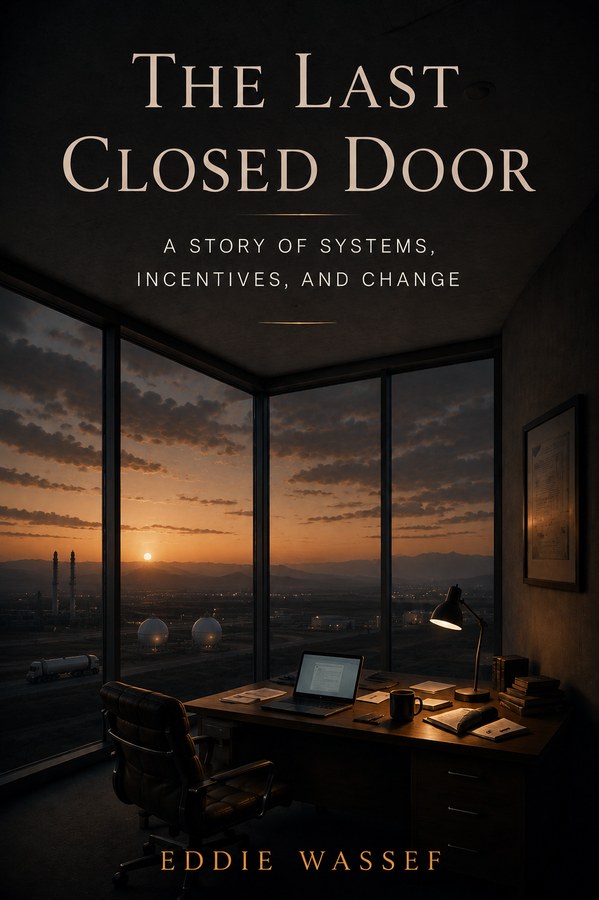
About the Book
For decades, the systems that run the world were built to last, and to stay closed.
Reliable. Controlled. Predictable. But as the world changed, the systems didn’t.
An enterprise architect looks back on a career spent inside one of the last closed enterprises: an industrial giant whose success was built on certainty, and whose survival now depends on giving some of it up.
The story runs through projects, budgets, hallway conversations, and a few decisions nobody thought were decisions at the time.
It is about technology, but mostly it is about incentives, inertia, and who carries the risk when nothing changes. Nothing is the expensive option.
7
Acts
56
Chapters
649
Pages
2026
First edition
Read the Opening
Chapter 1: Before
The thing I remember most clearly is that nobody in the room reacted.
It was a Tuesday afternoon, sometime in the spring, in a conference room on the kind of floor that has its own coffee machine and a view of a parking lot. Seven of us. A status review. The slide on the screen showed a capability we had been preparing to scope for the next quarter: architecture diagrams, vendor shortlist, three internal teams aligning calendars to align other calendars. A respectable enterprise effort.
While the meeting was happening, on a second monitor I had not bothered to close, a notification surfaced from a public repository I had been following out of professional curiosity. Someone I had never met, in a city I could not have placed on a map, had merged a pull request that did roughly what our slide proposed. Not the enterprise-grade version. Not the one with the audit hooks and the regional failover. But the working core of it. In an afternoon. With three other people he appeared to know only through their handles.
I closed the laptop and went back to the meeting.
That is the part I want to be honest about. I did not say anything. I did not point at the screen and say, look at this, the world we are pricing for next quarter just shipped for free while we were discussing the procurement path. I sat there and nodded at the right moments, because the meeting was real and the people in it were good at their jobs and the work we were debating was, by every measure we had been trained to apply, the correct work to be doing.
But something in me had moved a quarter inch, and I knew it.
The chapter continues for another nine pages.
Get the full bookWhere to Buy
Available now
Paperback and Kindle edition, out now on Amazon. Audiobook and Barnes & Noble to follow.
ISBN (paperback) 979-8-9964307-0-3
Still to Come
Know when the audiobook lands
The Audible and Barnes & Noble editions are still to come. Those announcements go out on LinkedIn and Medium — follow either and you won’t miss them.

The Author
Twenty years inside the rooms this book is set in.
From the Blog
Latest at Archetypical Software
Reading Groups
Discussion guide for teams and book clubs
Six questions to start with, whether you’re reading it with an architecture guild, a leadership team, or a book club that just wants the argument.
- Where in your own organization is a door being held closed out of habit rather than reason?
- The narrator says nothing in that first meeting. What would you have said, and what would it have cost you?
- “Governance is not the enemy. Invisible governance is.” Where is your governance invisible?
- The book argues enterprises run on hidden memory: seniority, folklore, knowing which meeting matters. What memory would you externalize first?
- Who in the story is right for the wrong reasons? Who is wrong for the right ones?
- “The point is not to create a temporary corporate initiative.” What of your current work would survive a leadership change?
Speaking & Events
Talks, panels, and internal sessions
Available for conference talks, engineering all-hands, architecture guilds, and leadership offsites. Topics include platform engineering, inner source, cloud native security, AI governance, and what it actually takes to open a closed enterprise.
Stages
Booking & press
Invite me through Sessionize, or reach out directly on LinkedIn.
Sessions and stages from sessionize.com/eddie-wassef · last updated 2026-08-24